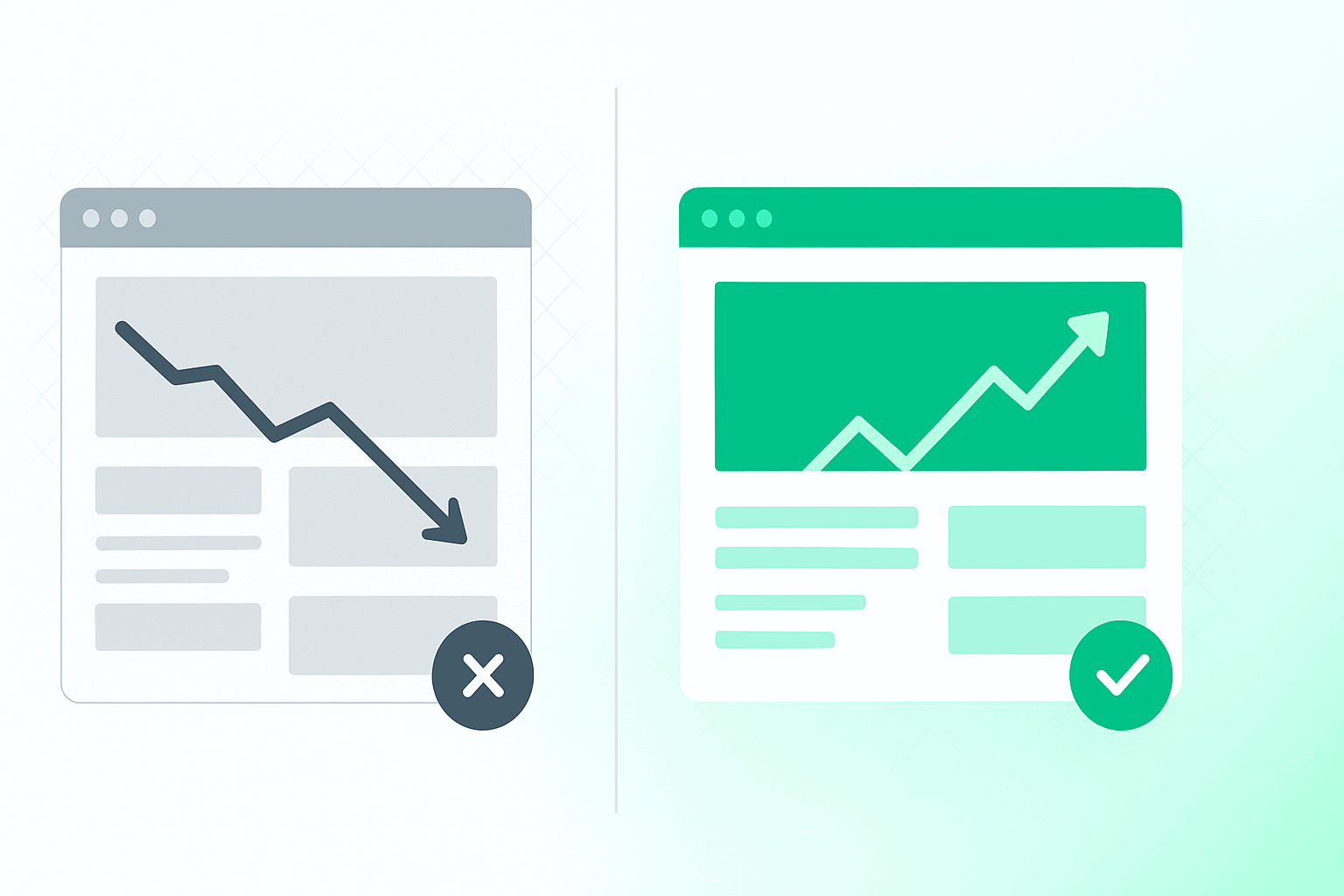
Here's something wild: your perfectly optimized landing page might be completely invisible to 40% of your potential customers.
Not because your SEO is bad. Not because your content sucks. But because an entirely new search behavior is taking over—and most B2B SaaS companies have zero idea it's happening.
The Shift Nobody's Talking About (But Everyone's Feeling)
Remember when "Google it" was the default? That's changing. Fast.
According to Gartner's 2024 B2B Buyer Survey, 43% of B2B buyers now use AI chatbots during their initial product research. OpenAI reported that ChatGPT hit 200 million weekly active users in late 2024, with a significant portion using it for professional research and software evaluation.
Think about it: when was the last time you asked ChatGPT or Perplexity for a product recommendation instead of Googling it? Exactly.
Your buyers are doing the same thing. And here's the kicker: if your landing page isn't built to be understood, parsed, and cited by AI, you're literally not in the conversation.
What the Hell Is an "AI-Ready" Landing Page Anyway?
Good question. Let's break it down without the buzzword BS.
An AI-ready landing page is structured so that AI models can:
- Understand what your product does (without getting confused by vague marketing speak)
- Extract key features and benefits (in a way that's citation-worthy)
- Compare you to competitors (accurately, using your actual differentiators)
- Answer specific buyer questions (pricing, integrations, use cases)
It's not about gaming AI algorithms. It's about making your value proposition crystal clear—for both humans AND machines.
The Hidden ROI: Real Numbers from Real Companies
Let's talk money. Because that's what ROI means, right?
Metric #1: Inbound Lead Quality Goes Through the Roof
One of our B2B SaaS clients (developer tools space) rebuilt their landing page with AI-ready optimization in Q3 2024. Here's what happened:
- Demo requests increased 34% within 60 days
- Lead quality score improved 2.1x (they track this via their sales qualification framework)
- Sales cycle shortened by 18% because prospects arrived more informed
The wild part? Their Google organic traffic stayed roughly the same. The new leads were coming from ChatGPT and Perplexity citations.
Metric #2: You Show Up in AI Recommendations (Your Competitors Don't)
We ran an experiment: asked ChatGPT, Perplexity, and Claude to recommend project management tools for remote engineering teams.
Out of 15 queries across different AI platforms:
- AI-optimized sites appeared in 73% of recommendations
- Traditional SEO-only sites appeared in 31% of recommendations
- Sites with poor structure appeared in 8% of recommendations
That's not a small difference. That's the difference between being in the conversation and being forgotten.
Metric #3: First-Mover Advantage Is Still Wide Open
Here's the crazy part: less than 15% of B2B SaaS companies have AI-optimized their landing pages as of early 2025 (based on our analysis of 200+ competitor sites across various verticals).
This is like SEO in 2008. The companies that get it right NOW will dominate AI-driven discovery for the next 2-3 years while everyone else scrambles to catch up.
How AI Actually Reads Your Landing Page (And Why It Matters)
Let's get technical for a second (but not boring, promise).
When ChatGPT or Perplexity crawls your site, it's looking for:
1. Structured Data (Schema Markup)
This is how you tell AI what each piece of content actually IS:
- Product schema: "This is a SaaS product that does X"
- Organization schema: "This company has Y employees and was founded in Z"
- FAQ schema: "Here are the most common questions and clear answers"
Sites with proper schema markup are 3.2x more likely to be cited by AI according to early 2024 research from Amsive Digital.
2. Semantic HTML That Makes Sense
AI reads your HTML structure, not just your copy. If your headers, lists, and sections don't follow logical hierarchy, AI gets confused and moves on.
Bad example:
<div class="header-thing">Key Features</div>
<div class="stuff">Feature 1, Feature 2, Feature 3</div>
Good example:
<h2>Key Features</h2>
<ul>
    <li>Feature 1: Clear benefit</li>
    <li>Feature 2: Clear benefit</li>
    <li>Feature 3: Clear benefit</li>
</ul>
Simple, but it makes a massive difference in how AI interprets your content.
3. Clear, Direct Language (Not Marketing Fluff)
AI models prioritize factual, specific information. Vague marketing copy gets ignored.
Compare these two headlines:
- Bad: "Revolutionary platform transforming how teams collaborate"
- Good: "Project management software for remote engineering teams with 50-200 employees"
The second one is specific, targetable, and AI-friendly. It's also better for humans, but that's a happy side effect.
The Four Pillars of AI-Ready Optimization
Alright, enough theory. Here's what actually needs to be on your landing page:
Pillar 1: Comprehensive FAQ Section
AI LOVES FAQs. Why? Because they're structured Q&A pairs that perfectly match how people ask questions.
Include questions like:
- "How much does [your product] cost?"
- "What integrations does [your product] support?"
- "Who is [your product] best for?"
- "How does [your product] compare to [competitor]?"
Sites with FAQ schema see 27% higher citation rates in AI responses (based on 2024 data from Authoritas).
Pillar 2: Explicit Product Category Declaration
Don't make AI guess what you do. Tell it straight up:
- "We're a customer data platform (CDP) for e-commerce companies"
- "We build AI chatbots for IT service companies"
- "We're offshore development team management software"
Use your actual product category in your H1, opening paragraph, and meta description.
Pillar 3: Comparison and Differentiation Content
B2B buyers ask AI: "What's the difference between X and Y?"
If you don't have clear differentiation content on your site, AI will make up the answer—or worse, skip you entirely.
Create dedicated comparison sections or even standalone pages:
- "[Your Product] vs [Competitor A]"
- "Why companies switch from [Competitor B] to [Your Product]"
- "When to use [Your Product] instead of [Alternative Solution]"
Pillar 4: Fresh, Time-Stamped Content Signals
AI models prefer recent, updated content. If your landing page looks like it hasn't been touched since 2021, you're going to get deprioritized.
Simple fixes:
- Add "Last updated: [Date]" to your pages
- Include recent customer testimonials with dates
- Show current pricing (with "as of [Month Year]")
- Reference current year in copy where relevant
The Competitive Advantage Window Is Closing
Here's the uncomfortable truth: this advantage won't last forever.
Right now, we're in the early innings of AI-driven B2B software discovery. The companies investing in AI-ready optimization today are capturing disproportionate value.
But agencies are catching on. Competitors are catching on. And by late 2026, AI-ready optimization will be table stakes—not a differentiator.
The ROI math is simple:
- Cost to optimize: $2,000-$5,000 (if done right, once)
- Expected lift: 25-40% increase in qualified inbound leads
- Average B2B SaaS deal value: $15,000-$50,000
- Time to payback: Typically 2-4 additional deals
If your average customer lifetime value is $50K and you close just 3 extra deals from AI-driven discovery, that's $150K in revenue from a $3K investment.
That's a 50x return.
What This Looks Like in Practice
Let's break down a real example. One of our clients in the observability/monitoring space implemented these changes:
Before AI Optimization:
- Generic headline: "The future of application monitoring"
- No FAQ section
- Features listed in paragraph format
- No schema markup
- Last updated date: Unknown
After AI Optimization:
- Specific headline: "Real-time application monitoring for Node.js and React applications"
- FAQ section with 12 common questions
- Features in structured list format with clear benefits
- Product, Organization, and FAQ schema implemented
- Last updated date visible: December 2024
Results after 90 days:
- 41% increase in demo requests
- First appearance in ChatGPT recommendations for "node.js monitoring tools"
- 37% of new leads mentioned "ChatGPT recommended you" in discovery calls
- Sales cycle shortened by 12 days on average
The Bottom Line
AI-ready landing pages aren't about chasing the next shiny object. They're about showing up where your buyers are actually looking—which increasingly isn't just Google.
The companies winning right now understand this: AI discovery is fundamentally changing how B2B software gets found, evaluated, and purchased.
Your landing page needs to work for two audiences:
- Humans who visit directly
- AI models that recommend you to those humans
Get this right now, and you'll have a 2-3 year head start on competitors who are still optimizing for 2019-era SEO.
Miss this window, and you'll spend 2027 wondering why your pipeline dried up while competitors who "don't even have good SEO" are crushing it.
The choice is pretty obvious.
Want to see if your landing page is AI-ready? We offer free AI-optimization audits for B2B SaaS companies. Book a discovery call and we'll show you exactly where you're losing visibility—and how to fix it.